

The economy is not simply going up.
And it is not simply going down.
It is doing both at the same time.
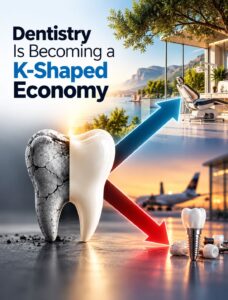
This is what economists describe as a K-shaped economy.
On the upper arm of the K are those who own assets: stocks, real estate, companies. Since 2020, many of these assets have appreciated enormously. The S&P 500 has reached record levels, while US house prices have risen dramatically since the pandemic.
On the lower arm are those who largely depend on their income.
For them, the picture can look completely different.
Rent is higher. Food is more expensive. Housing has become increasingly difficult to afford. While asset owners have participated in the enormous creation of wealth of the last few years, those without assets have often experienced exactly the opposite sensation: working harder simply to maintain the same standard of living.
The numbers explain why these two apparently contradictory realities can coexist.
According to Federal Reserve data, the richest 10% of Americans own the overwhelming majority of stocks and approximately two-thirds of total wealth, while the bottom 50% owns only a tiny fraction.
Same economy. Two completely different experiences.
And I believe something very similar is beginning to happen in dentistry.
For decades, most dental practices essentially served the middle.
There were extremely wealthy patients and economically disadvantaged patients, obviously, but between them existed a huge middle class capable of accepting comprehensive dentistry when properly explained and distributed over time.
That middle is under pressure.
And if our patients themselves are progressively separating along the two arms of the K, dentistry will inevitably follow them.
But I believe something even more interesting will happen.
The two arms of the K may not simply receive the same dentistry at two different prices.
They may increasingly receive two completely different kinds of dentistry.
At the lower end of the market, affordability, speed and standardization will inevitably become increasingly important.
And which treatments are easiest to standardize?
Very often, replacement treatments.
Extraction and implant placement are, in many situations, easier to protocolize than the complex preservation of a compromised tooth. Digital planning, guided surgery, immediate loading and standardized prosthetic workflows can make replacement increasingly reproducible and scalable.
The same treatment can also be concentrated into a few days.
And once treatment becomes standardized and compressible in time, something else happens:
it becomes geographically transportable.
Patients can travel.
They can take a plane and receive extensive implant treatment in another country within a few days at prices that a local practice may simply be unable to compete with.
At that point, competing on price becomes extremely difficult.
There will always be another organization with greater scale, lower labour costs or a different economic environment capable of doing it for less.
This creates a strange paradox.
The dentistry that is economically cheaper today may sometimes be the dentistry with the highest biological cost.
Extraction is irreversible.
Every tooth removed eliminates something biology created and that dentistry can never truly reproduce.
An implant can be an extraordinary treatment when it is necessary. But an implant is a replacement, not a biological equivalent of a tooth.
And the real cost of replacement may not appear on the day the implant is placed.
It may appear ten, fifteen or twenty years later.
At the first important biological or mechanical complication, the equation changes.
Loss of tissue, peri-implant disease, prosthetic complications, implant failure, additional surgery, bone reconstruction and increasingly complex retreatments can create both an enormous human cost and economic cost.
This becomes especially relevant as our patients live longer.
A treatment that appears simple and inexpensive at 45 may have a very different biological balance sheet when that patient is 70 or 80.
And here the two arms of the dental K begin to diverge not only economically, but philosophically.
On one arm, I can imagine dentistry becoming increasingly efficient, standardized and replacement-oriented.
Less prevention.
Less time devoted to maintenance.
Less complex preservation of severely compromised teeth.
More extraction and replacement.
More standardized implant solutions.
Faster treatment.
Lower prices.
Greater scalability.
At the opposite end, something almost completely different may emerge.
A dentistry based on prevention, preservation and longevity.
Instead of asking:
“How quickly can I replace this tooth?”
the question becomes:
“How long can I keep this patient’s biology intact?”
That requires completely different resources.
Periodontal prevention and maintenance.
Risk assessment.
Early diagnosis.
Adhesive dentistry.
Endodontics.
Periodontal therapy.
Orthodontic strategies.
Complex restorative procedures.
Minimally invasive prosthodontics.
And sometimes combinations of several disciplines simply to avoid removing something that cannot be replaced biologically.
There is another paradox here.
Preservation often looks less spectacular than replacement.
Saving a compromised tooth may require more judgment, more appointments, more different skills and sometimes more uncertainty than extracting it and following a standardized implant workflow.
It is therefore more difficult to industrialize.
And precisely because it is difficult to industrialize, it may become increasingly valuable.
This is where the K-shaped economy becomes, in my opinion, a fascinating model for understanding the future of our profession.
The lower and upper arms may not simply represent cheap dentistry and expensive dentistry.
They may represent two different value propositions:
Replacement, standardization, speed and price on one side.
Prevention, preservation, personalization and longevity on the other.
Neither implants nor replacement dentistry are the enemy. There are countless situations in which replacement is the correct treatment, and modern implant dentistry is one of the greatest achievements of our profession.
The distinction is somewhere else.
The danger begins when replacement becomes the default because it is easier to standardize, sell and scale—not because it represents the best biological decision for that individual patient.
And this brings us back to the dentist.
Which arm of the K are you preparing to serve?
There is no morally superior patient population.
But there are very different strategies.
If you decide to compete on the lower arm, you will need efficiency, organization, purchasing power, standardized workflows, financing, speed and scale.
Large organizations will probably have an enormous advantage there.
If you decide to move toward the opposite arm, your assets must be different.
In economics, those who moved upward in the K were largely those who already owned assets.
Dentistry has its own assets.
They are competence, courage and vision.
Competence is an asset because preservation is rarely achieved by one technique.
It comes from having enough knowledge and enough different clinical tools to create alternatives where someone else sees only extraction.
The ability to save teeth others would extract.
To manage periodontal breakdown.
To restore severely compromised teeth.
To manipulate occlusion.
To use orthodontics, adhesive dentistry, endodontics and prosthodontics together.
To know when an implant is genuinely the best solution—and when it isn’t.
These skills accumulate like capital.
Then there is courage.
Because preservation sometimes means choosing the more difficult road.
It means investing time in treatments that are less standardized and less immediately scalable.
It means accepting that the best biological treatment may not always be the easiest treatment to perform or the easiest treatment to sell.
And finally there is vision.
Because technology, AI and digital workflows will make standardized dentistry increasingly easy to reproduce.
That is good for dentistry and good for patients.
But it creates a paradox:
the easier a treatment becomes to standardize, the more exposed it becomes to price competition.
If the same treatment can be digitally planned, reproduced, packaged and delivered almost anywhere, geography becomes less important and price transparency becomes brutal.
Complex biological preservation works differently.
Judgment is harder to export.
Experience is harder to standardize.
Multidisciplinary thinking is harder to automate.
And trust is extremely difficult to commoditize.
This is why I believe the real divide in dentistry over the next decades may not be between analogue and digital dentistry, or between implants and natural teeth.
It may be between two completely different concepts of value.
One optimizes the cost of treatment today.
The other optimizes the biological cost over a lifetime.
And those two numbers are not necessarily the same.
In economics, the people who benefited most from the K were those who accumulated assets before everybody clearly understood what was happening.
Perhaps dentistry will work in exactly the same way.
You cannot suddenly acquire twenty years of clinical judgment when the market finally decides that judgment is valuable.
You cannot become excellent at preservation overnight.
You cannot build reputation overnight.
These assets have to be accumulated before you need them.
So perhaps the question for the next ten years of our profession is not simply:
“How much will dentistry cost?”
It is:
“What kind of dentistry will people be buying?”
I suspect the answer will increasingly lie at the two extremes.
One side will sell efficiency, replacement, speed and affordability.
The other will sell prevention, preservation, competence and longevity.
And between them there may be a progressively shrinking middle.
The K is already visible in the economy.
We should probably start asking ourselves whether it is becoming visible in dentistry too.
And most importantly:
Which arm are you building your practice for?