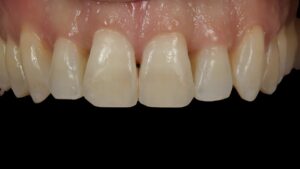


A direct restorative strategy centered on substrate preservation, emergence-profile redesign, Mylar-generated surface quality and monolithic composite.
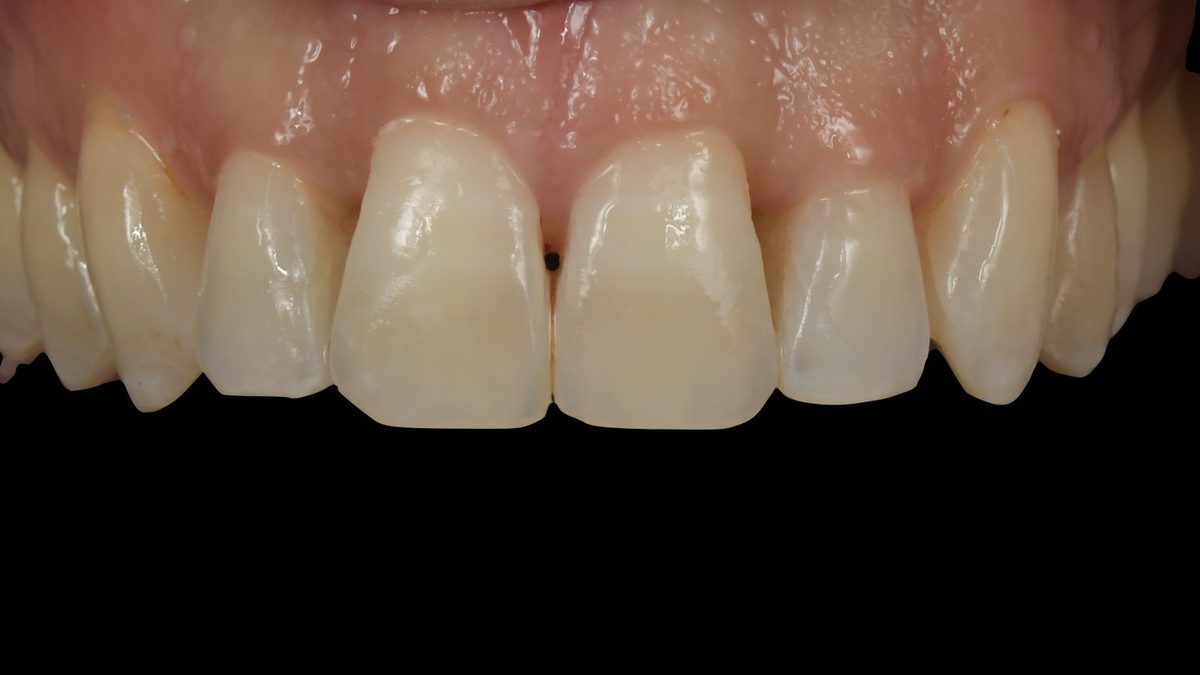
Treat the black triangle as an anatomical and biological problem – not simply a space to be filled.
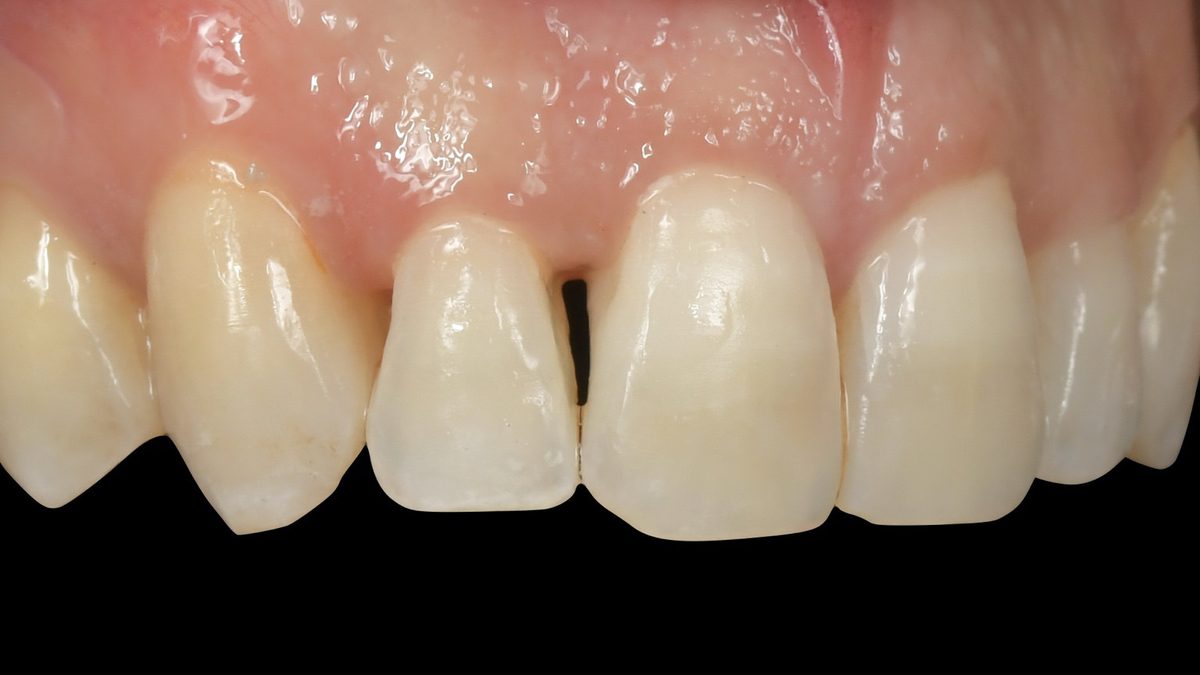
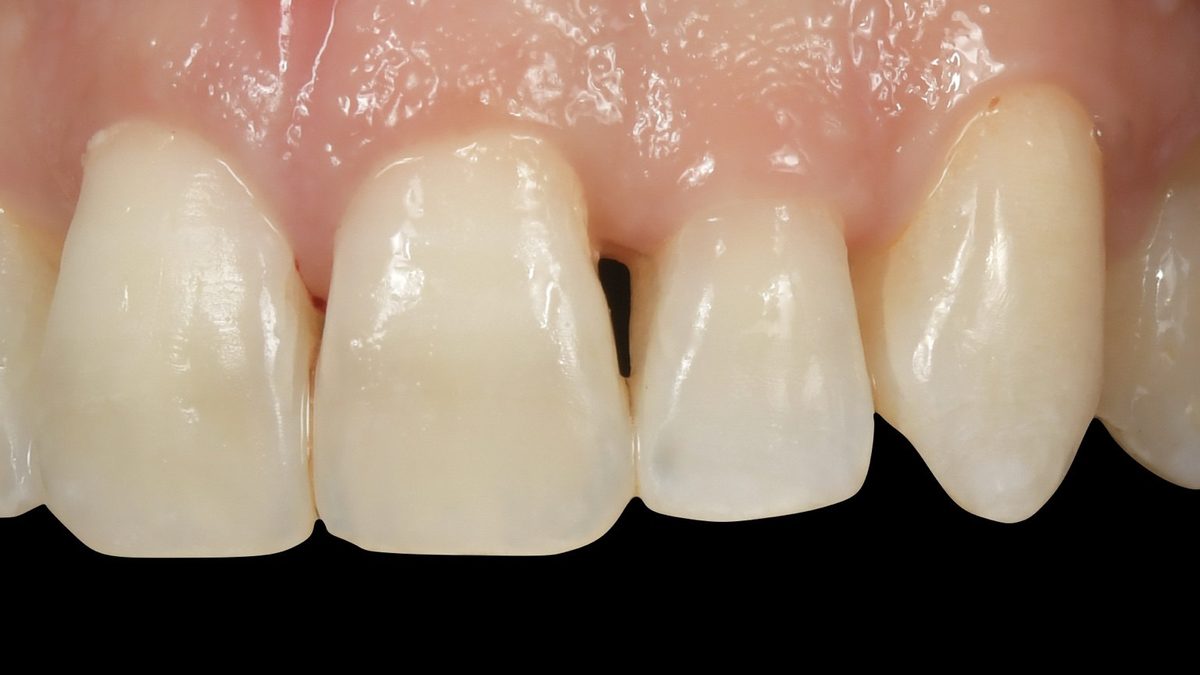
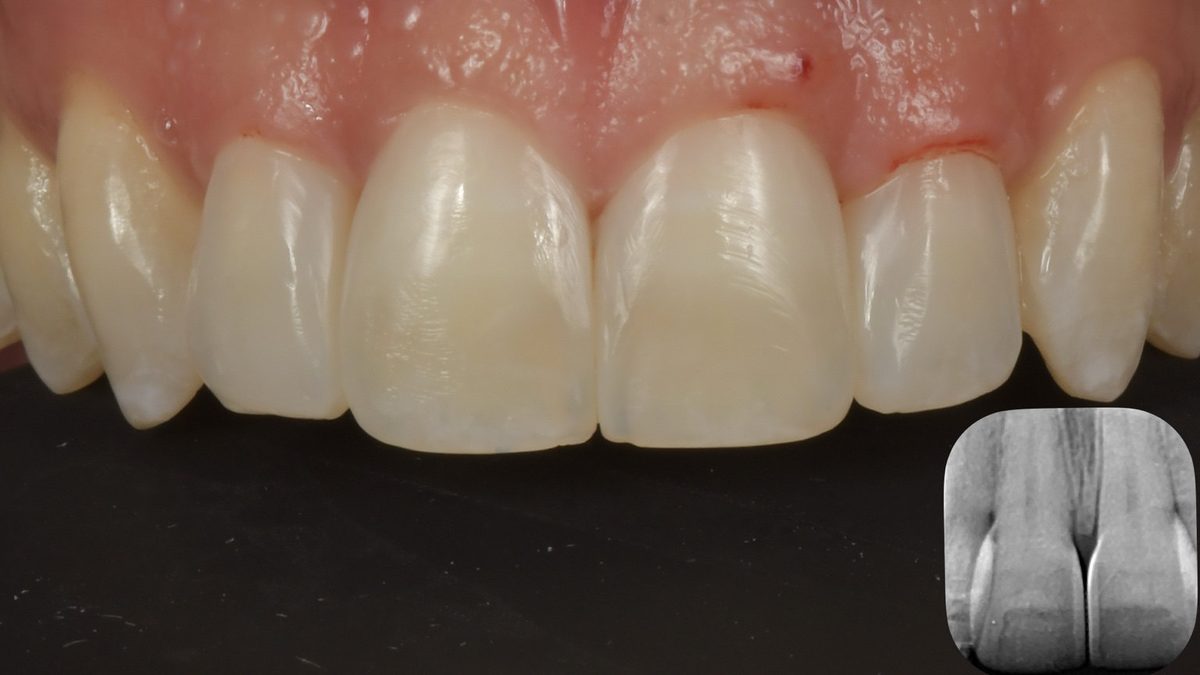
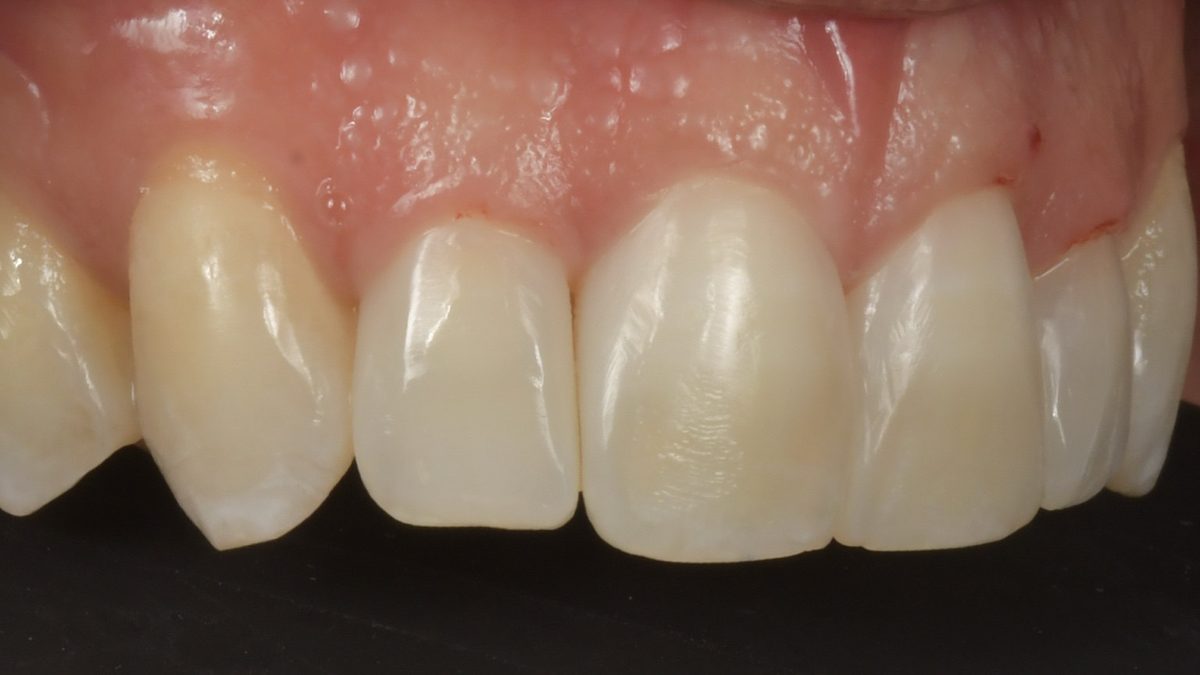
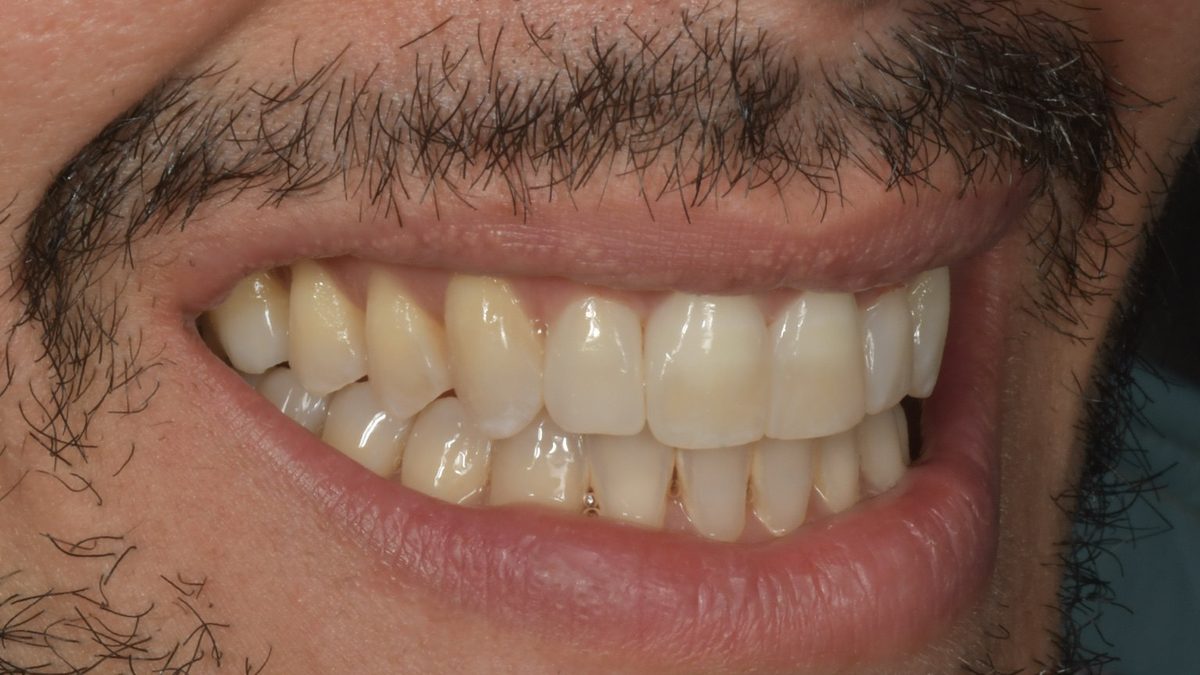
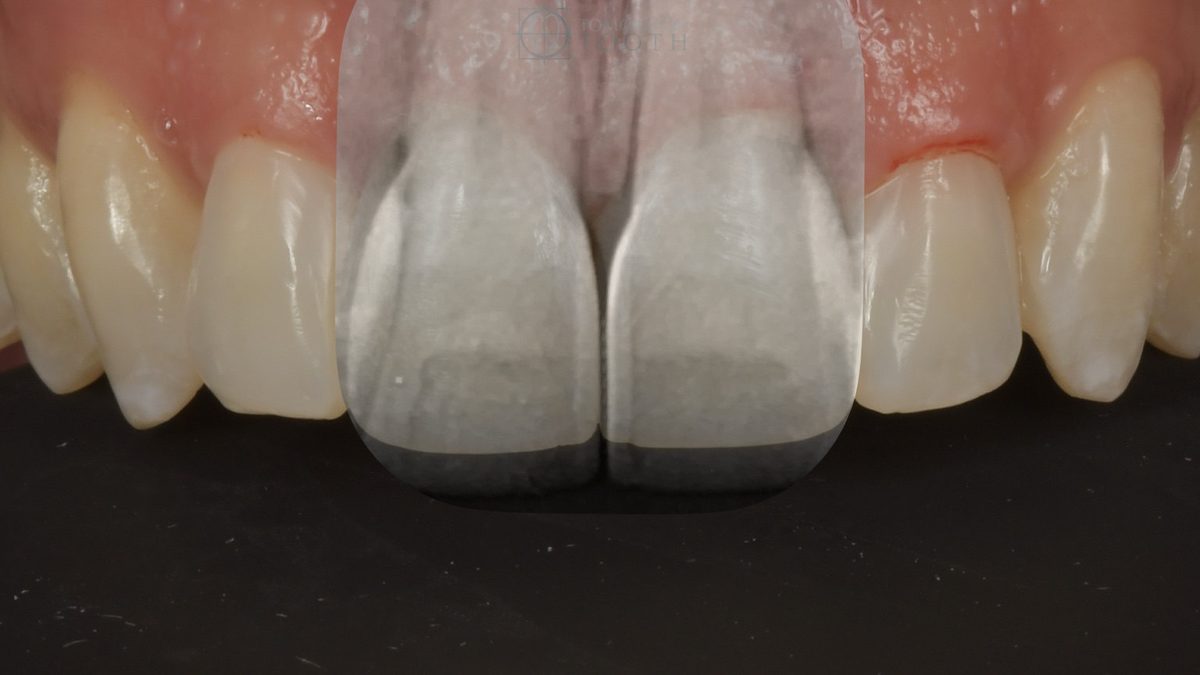
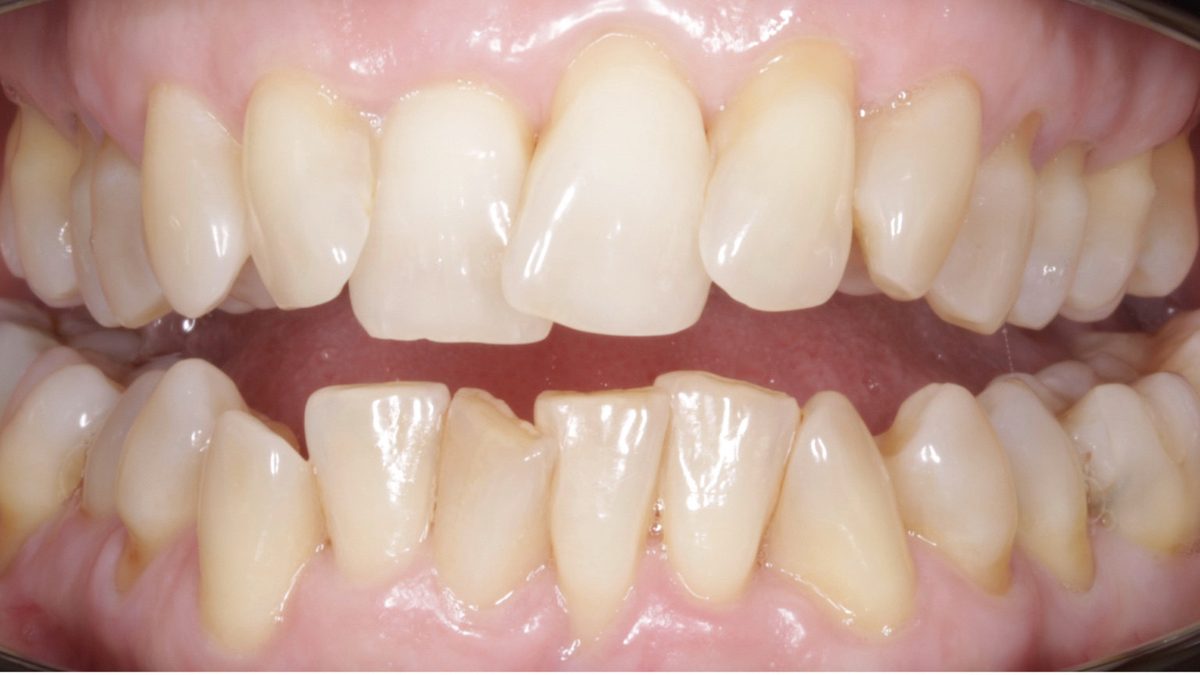
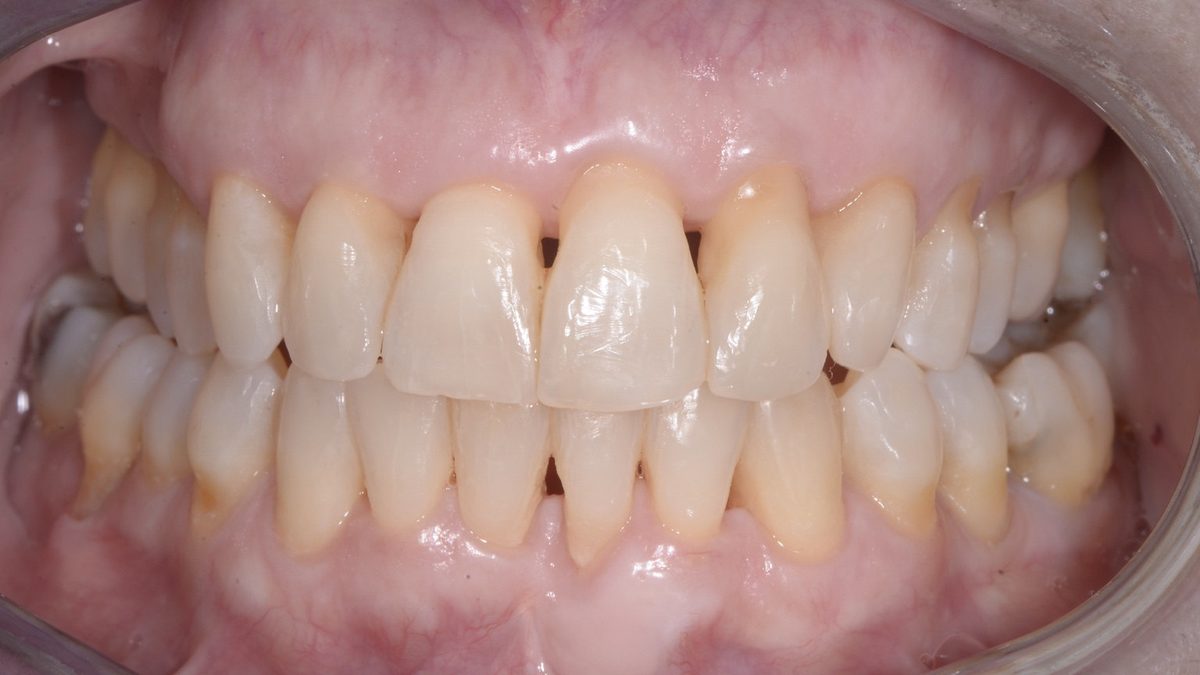
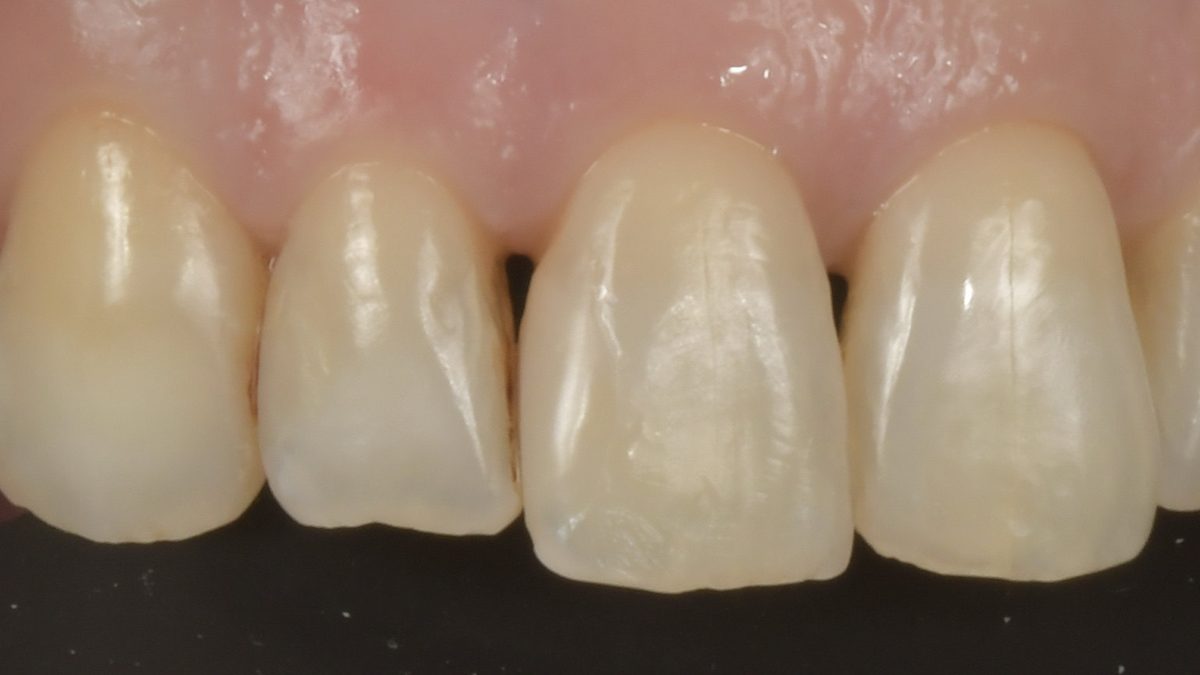
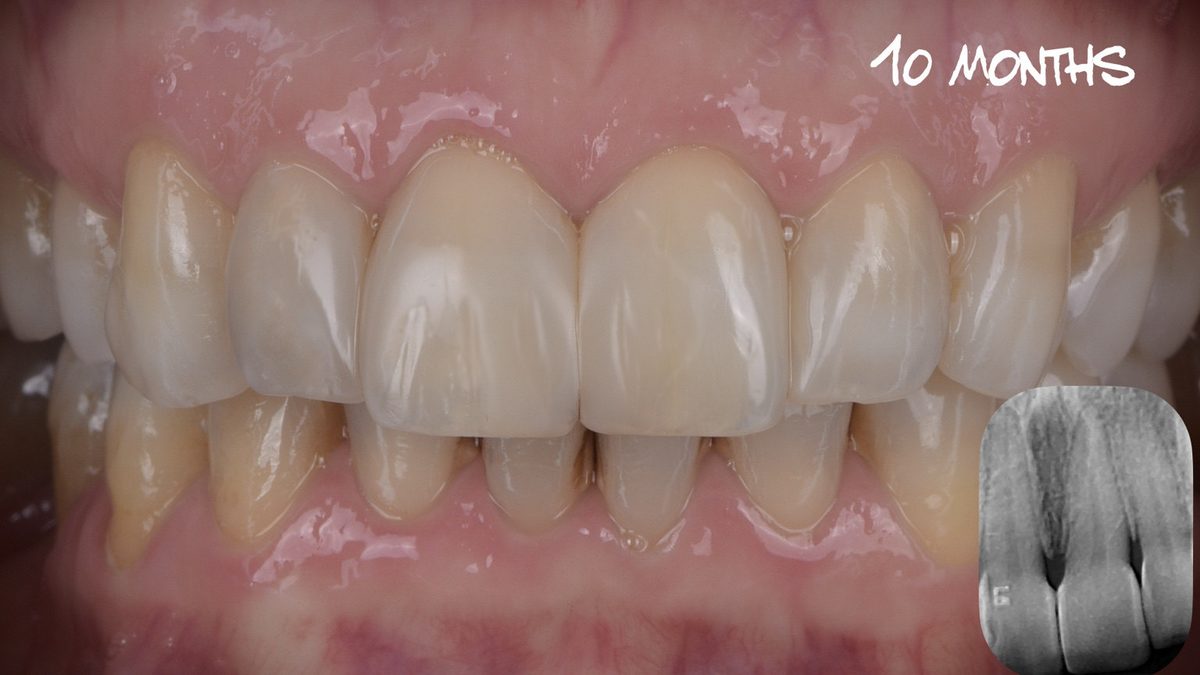
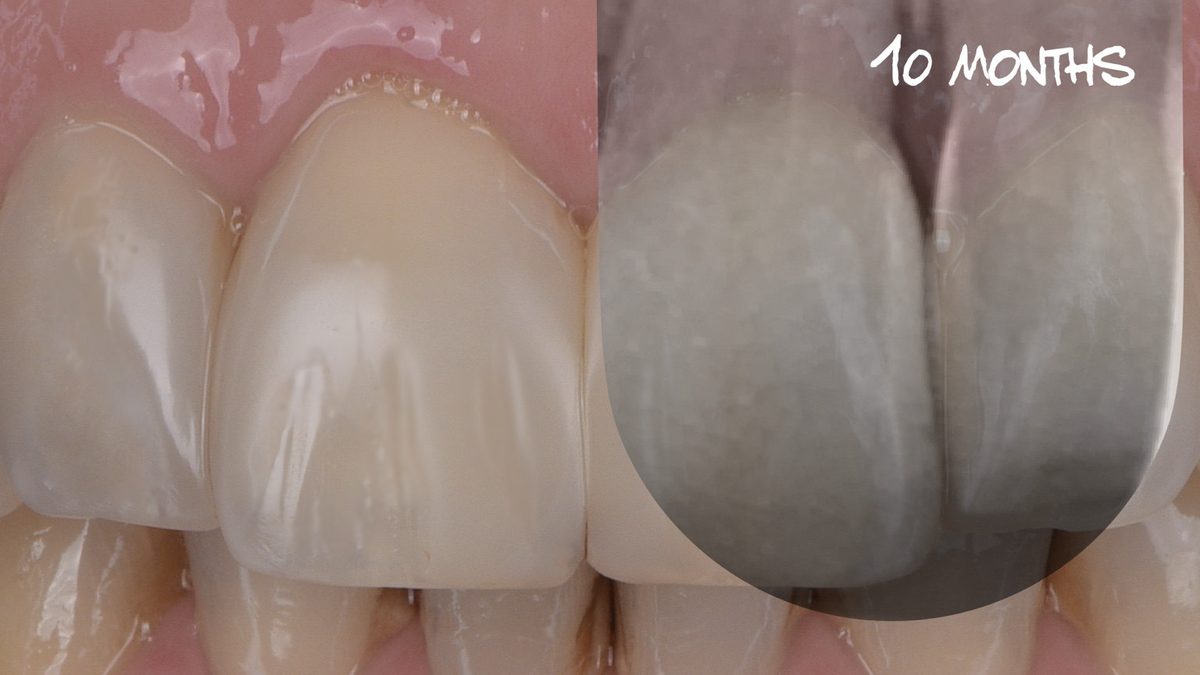
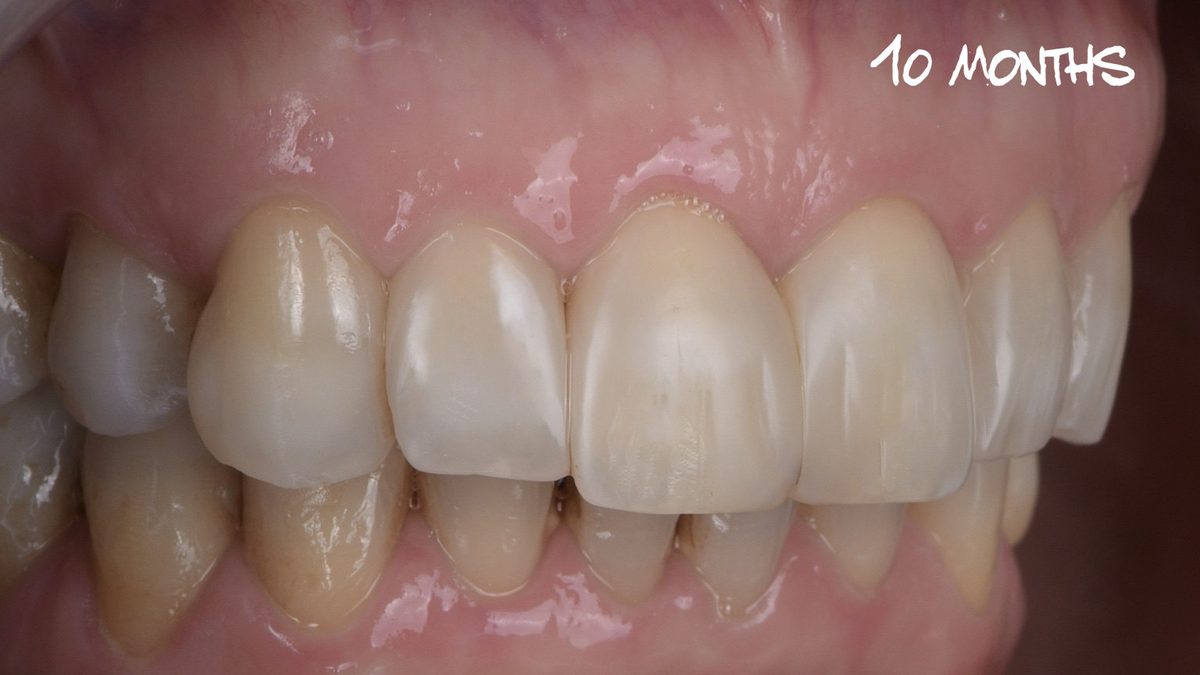
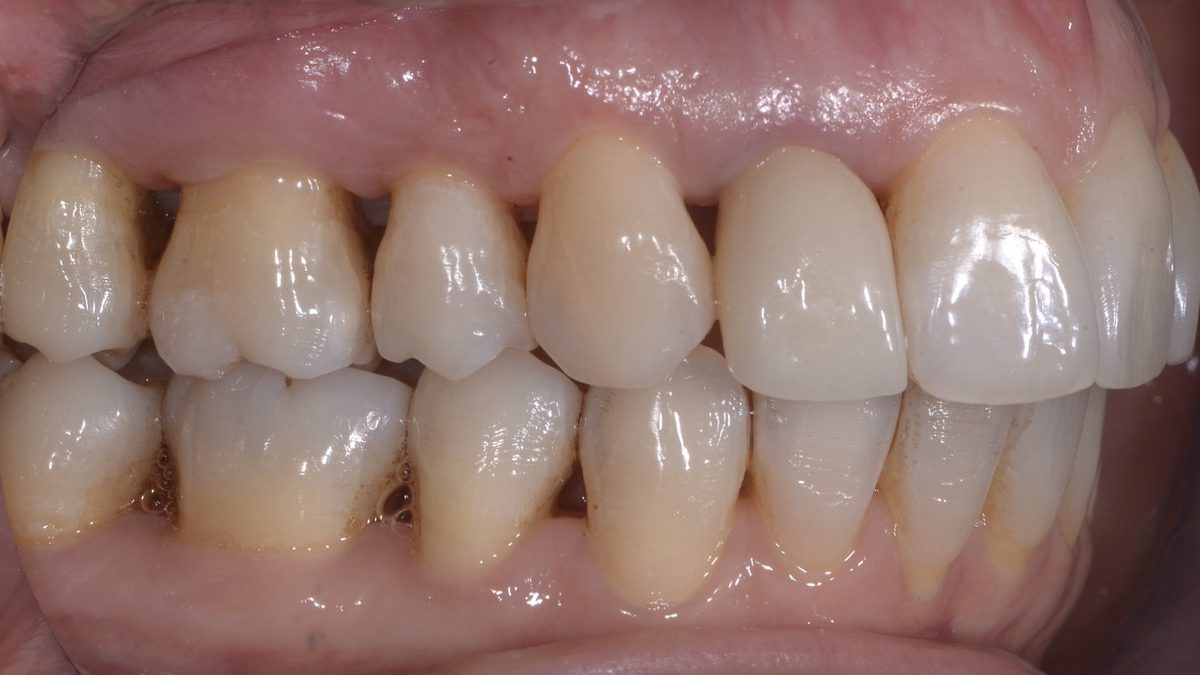
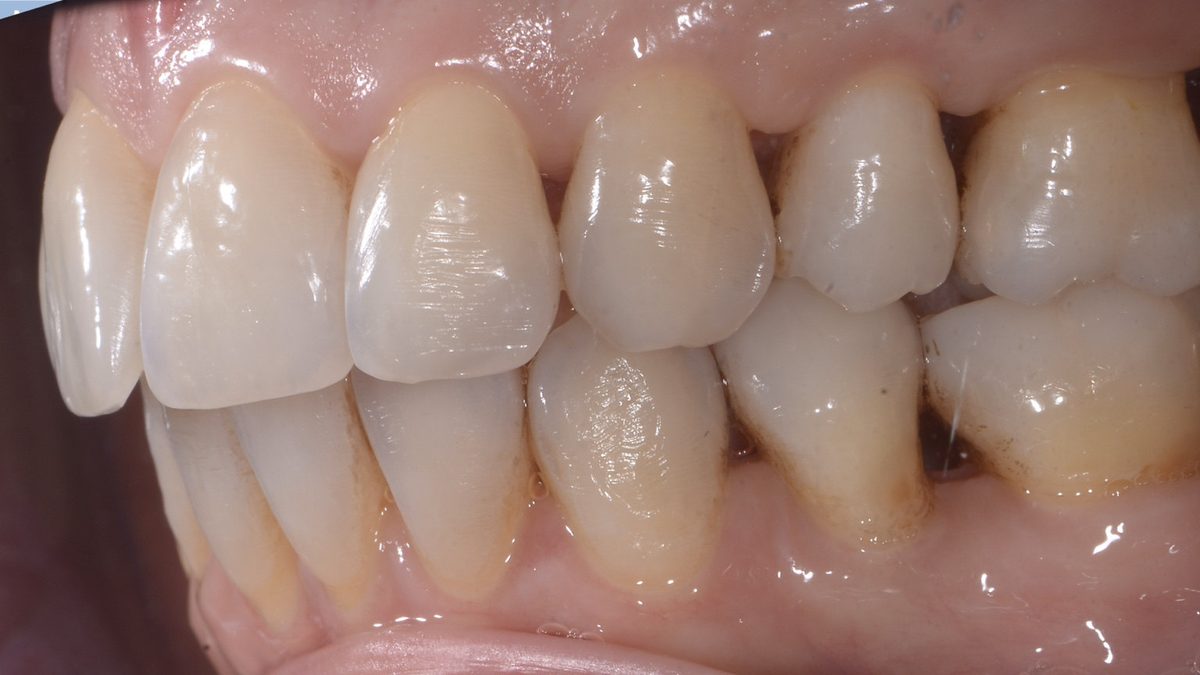
Black triangles are one of those clinical conditions in which the perception of the dentist and that of the patient may be remarkably different. From a professional point of view, the loss of an interdental papilla may appear to be a relatively minor problem, especially when periodontal health is stable and oral hygiene can be adequately maintained. For the patient, however, the dark space created between two anterior teeth can become one of the most visible and disturbing elements of the smile. (Figs. 1-10)
This discrepancy becomes particularly evident after adult orthodontic treatment. Teeth that were previously crowded may have masked a deficient papilla because their contact areas were displaced or overlapped. Once the teeth are correctly aligned and the contact point moves coronally, the underlying tissue deficiency becomes visible. The orthodontic result may therefore be objectively successful while the patient suddenly discovers a new aesthetic problem: perfectly aligned teeth separated by dark triangular spaces. (Figs. 11-12)
This should not be underestimated. In patient perception, black triangles rank among the smile defects perceived as particularly unattractive, even ahead of dental crowding. In other words, what the clinician may interpret as a small anatomical imperfection can become a major aesthetic issue for the person looking at the smile every day.
The clinical question is therefore not simply how to ‘fill a space’. It is how to modify the interproximal anatomy while preserving as much healthy dental structure as possible, creating an emergence profile that is biologically compatible, maintainable, smooth and visually integrated with the tooth.
01 · Additive logic
An additive problem deserves an additive solution
One of the greatest advantages of treating black triangles with direct composite is that, in the majority of cases, the procedure can be completely additive.
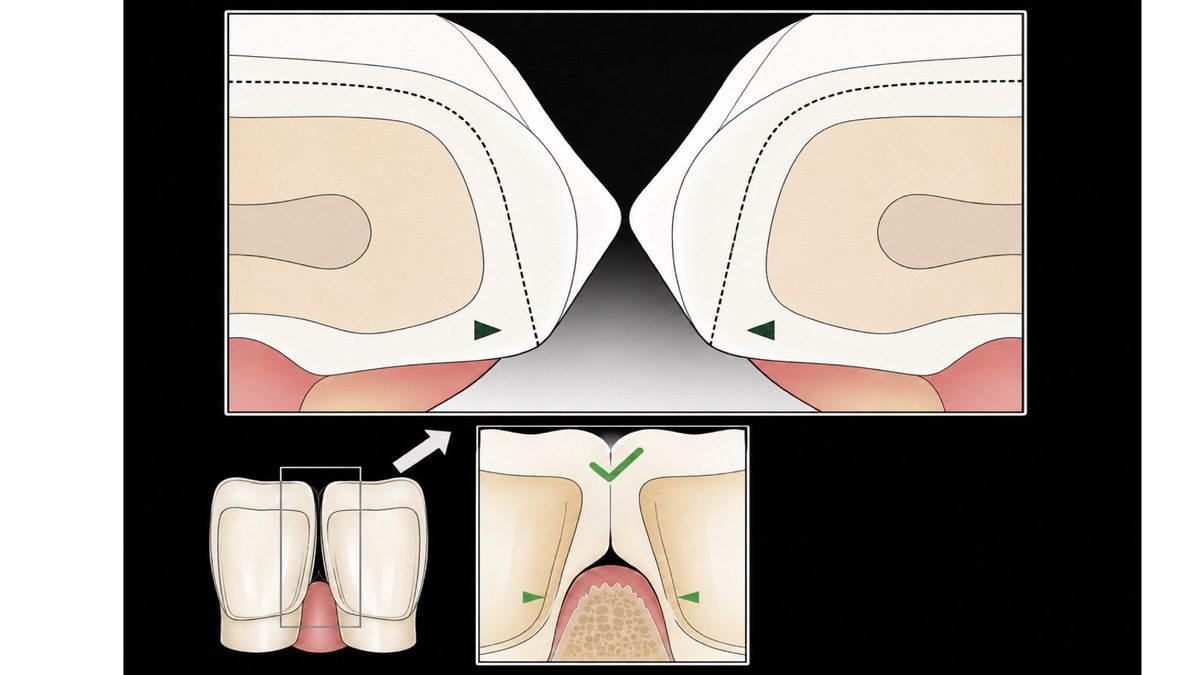
There is no cavity to prepare. There is usually no need to remove enamel simply to create mechanical retention. The restoration is retained through adhesion and extends over the natural convexity of the tooth. The transition between root surface, cervical enamel and the more coronal tooth structure already provides the geometry required to create a smooth restorative transition.
This changes the biological cost of treatment dramatically.
Traditional indirect approaches may solve the aesthetic problem, but closing a black triangle with ceramic veneers can require substantial interproximal extension. To bring the new emergence profile sufficiently cervical, the preparation may need to extend deeply interproximally and toward the palatal surface. What began conceptually as a veneer may progressively resemble a much more extensive preparation. (Fig. 13)
Direct composite allows us to reverse the logic. Instead of removing healthy tissue to create space for a restoration, we use the existing tooth as the substrate and add only the volume required to change its morphology.
This is an important distinction. Minimally invasive dentistry is often discussed in terms of making smaller preparations. In black-triangle treatment we can frequently go one step further: no preparation at all.
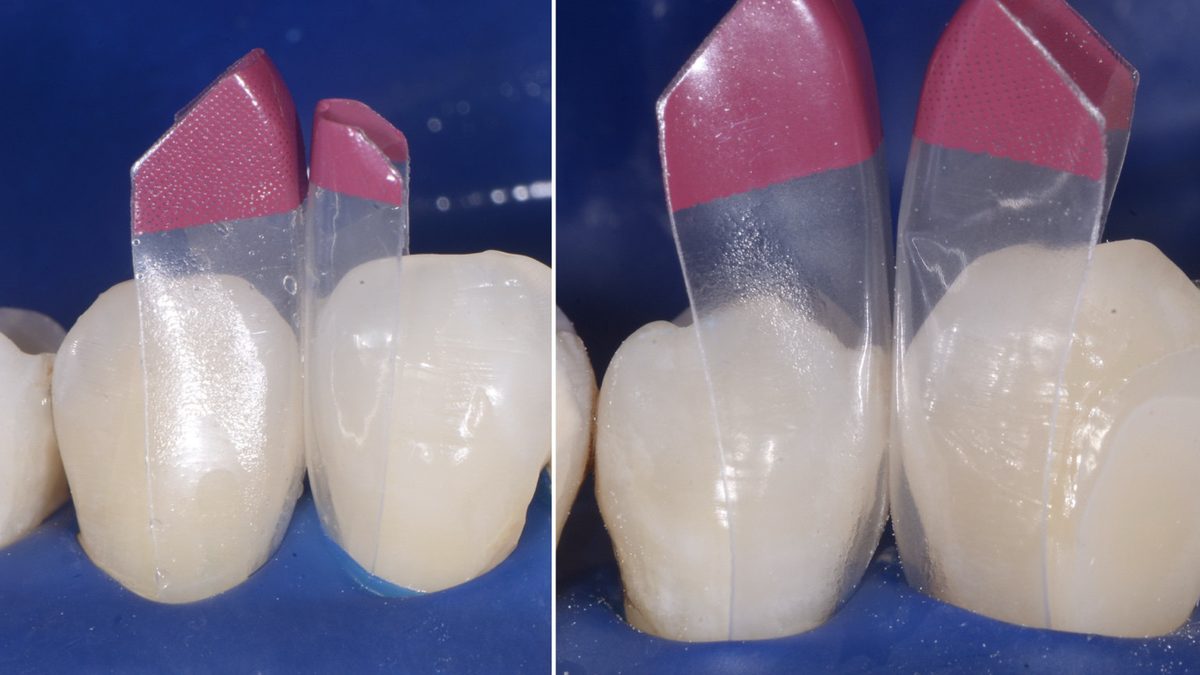
The bur is therefore not the instrument that defines the anatomy. The matrix does. To manage these restorations, however, not all matrices perform in the same way. We need matrices with specific features for these conditions. The matrices used in these cases are Bioclear Black Triangle matrices, purposely designed for this goal.
No preparation is not a smaller preparation. It is a different biological philosophy.
02 · Substrate management
The real challenge starts before bonding
A completely additive procedure sounds technically simple, but paradoxically it makes substrate management even more important.
When a conventional cavity is prepared, part of the contaminated superficial dental substrate is mechanically removed during preparation. In a black-triangle restoration, nothing is removed. We are attempting to bond directly to an untouched interproximal surface – and that surface represents one of the most difficult areas of the mouth to clean.
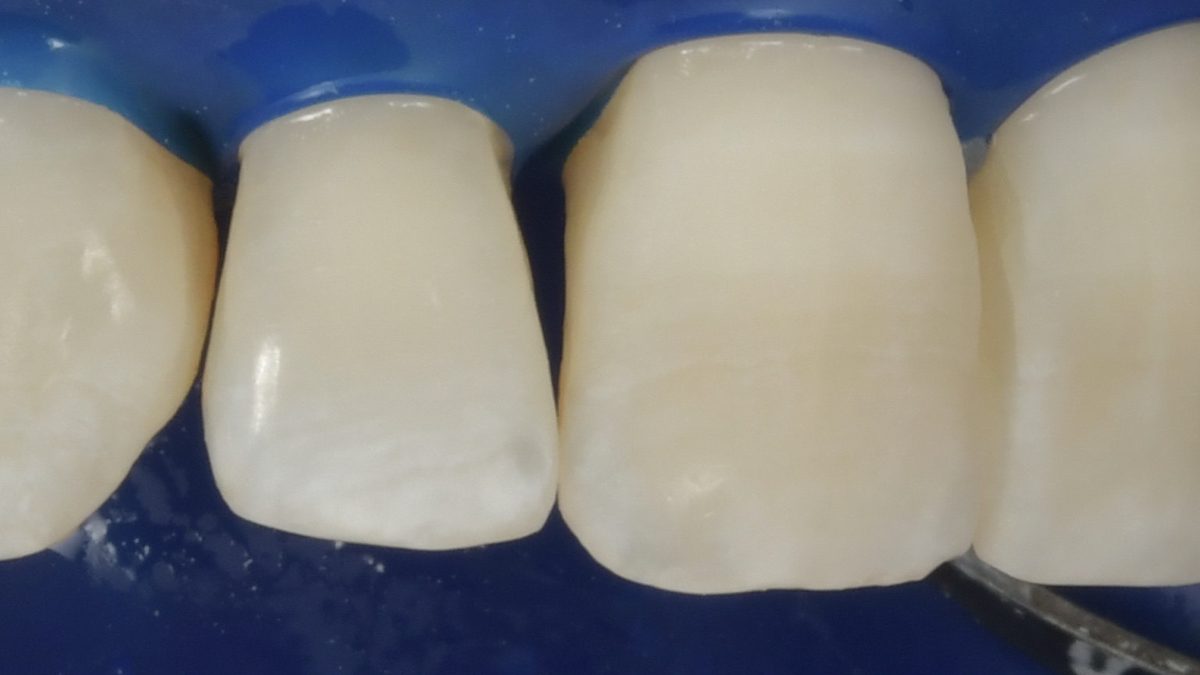
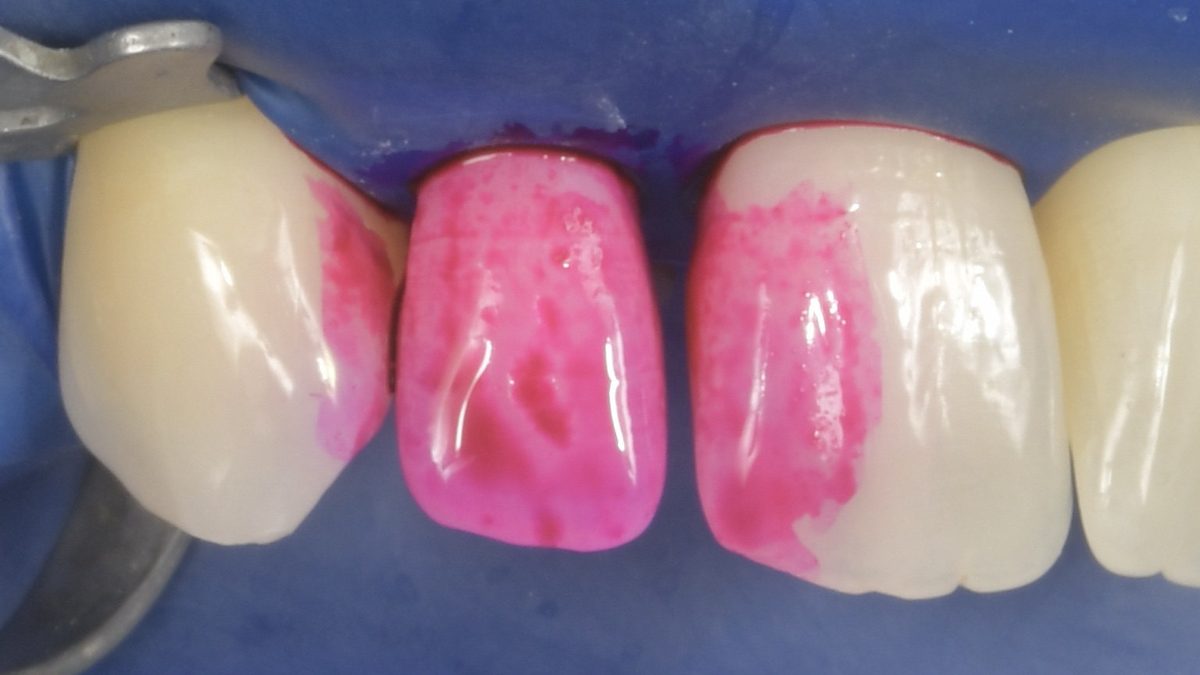
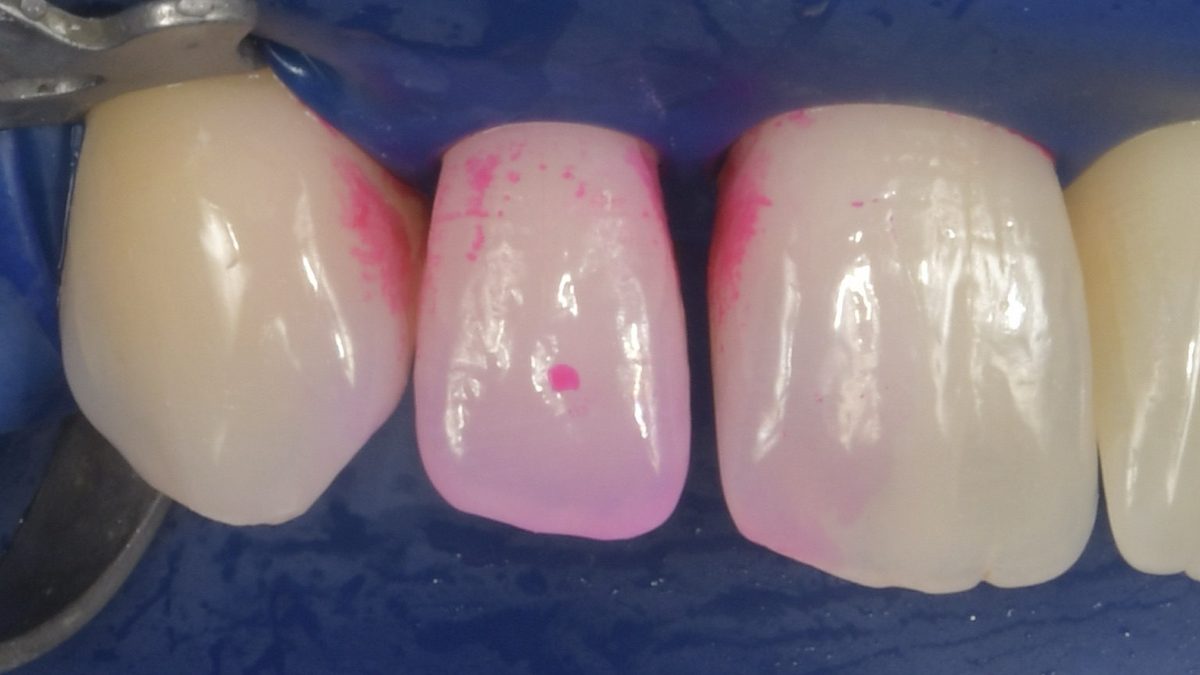
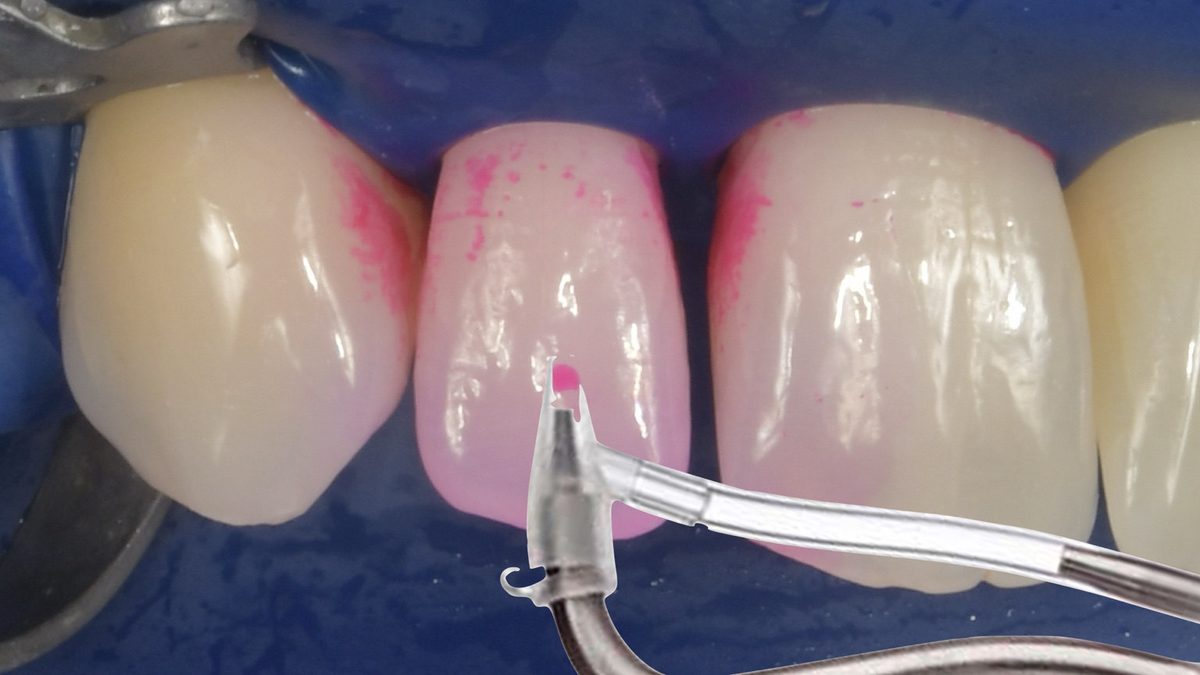
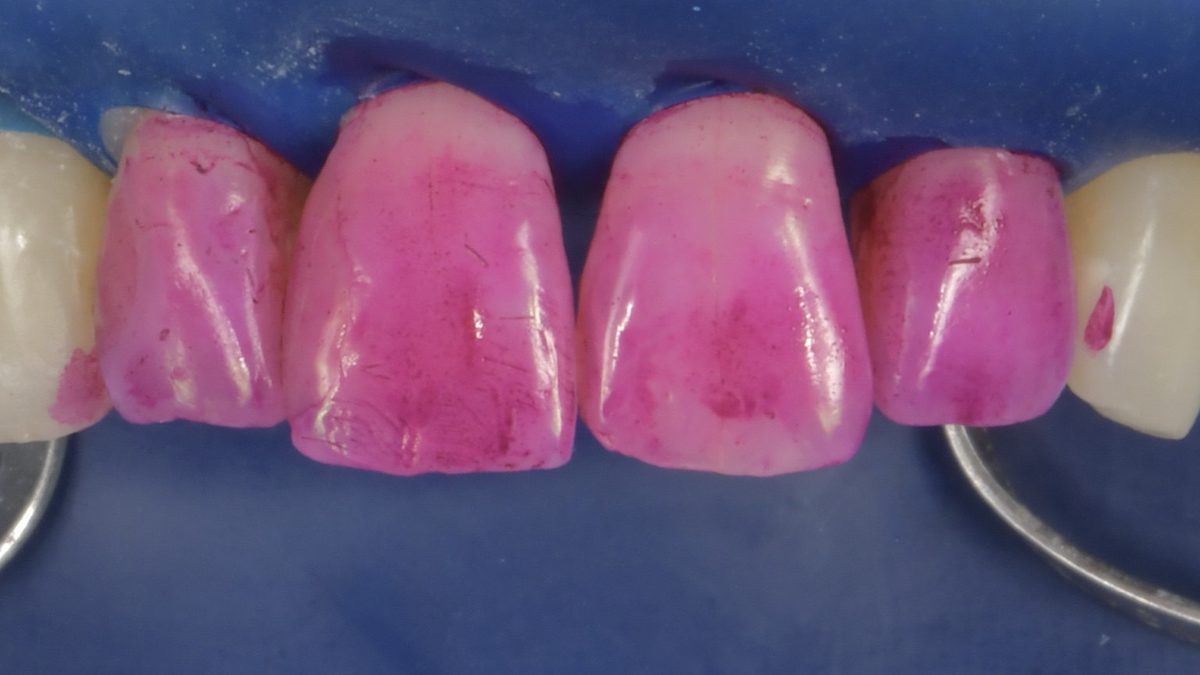
The tooth may look perfectly clean. The patient may have excellent oral hygiene. Professional prophylaxis may even have been recently performed. Yet plaque-disclosing agents frequently reveal persistent structured biofilm precisely on the proximal surfaces and cervical line angles where composite is about to be added. (Figs. 14-17)
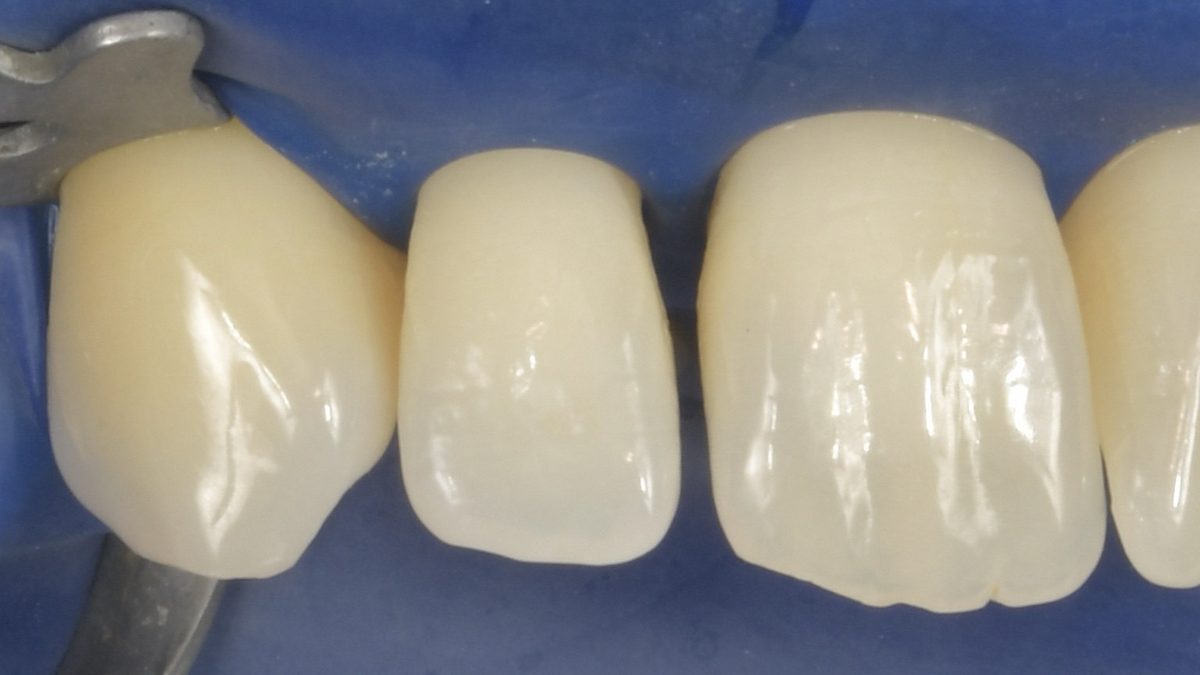
The protocol therefore considers plaque disclosure followed by systematic air-abrasive surface treatment a prerequisite rather than an optional refinement. A typical sequence is rubber-dam isolation, plaque disclosure, rinsing and visualization of residual biofilm, air-powder decontamination, and a final rinse before the adhesive procedure.
This step changes the way we should think about blasting. Its purpose is not to create macroscopic mechanical retention. We are not ‘roughening the tooth’ in the traditional sense. We are cleaning the adhesive substrate at a microscopic level, removing organic contamination from areas that conventional polishing and home hygiene cannot predictably reach.
Adhesion starts with cleanliness.
A sophisticated bonding agent placed over residual biofilm remains a bonding agent placed over residual biofilm.
For this reason, the quality of the final restoration is partly determined before the first drop of adhesive ever touches the tooth.
03 · Three-dimensional anatomy: we are not filling the triangle, we are redesigning the emergence profile
Closing a black triangle is not simply a question of adding composite until the dark space disappears.
The central anatomical issue is the emergence profile.
Loss of the papilla exposes a space between two teeth. If composite is added only coronally, the space may visually decrease, but the cervical contour remains deficient. If excessive material is placed without anatomical control, the opposite problem is created: an overcontoured restoration that is difficult to clean and potentially unfavorable for periodontal health.
The objective is therefore to create a new cervical contour that emerges progressively from the root surface toward the contact area.
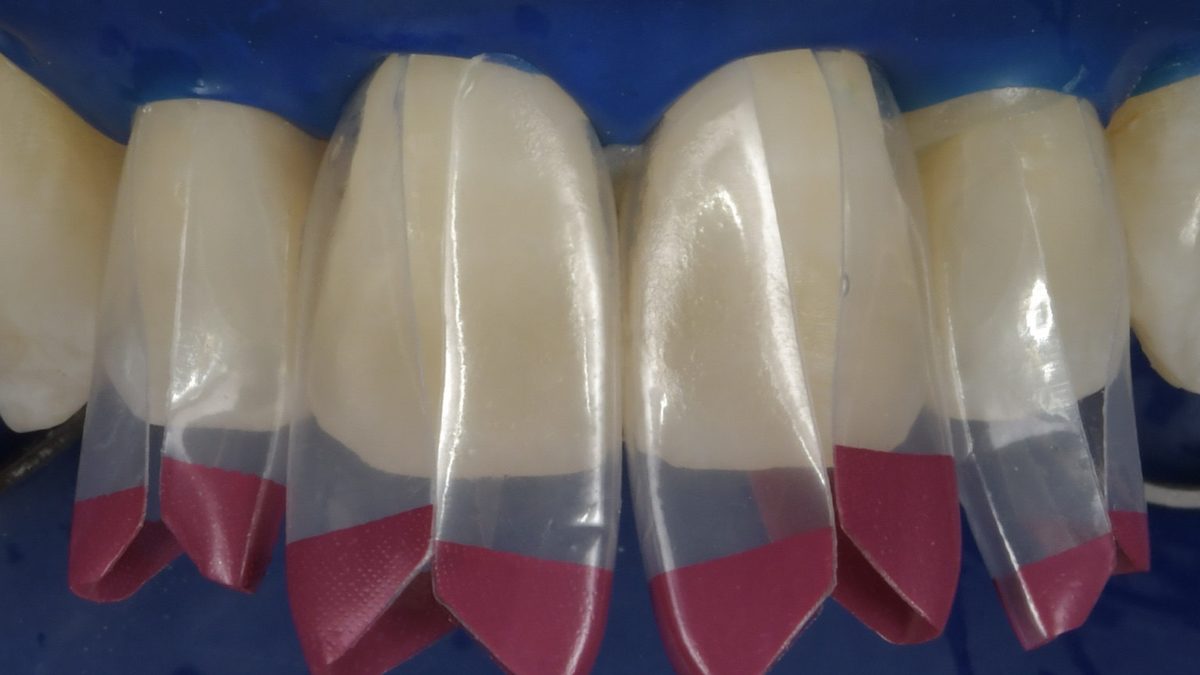
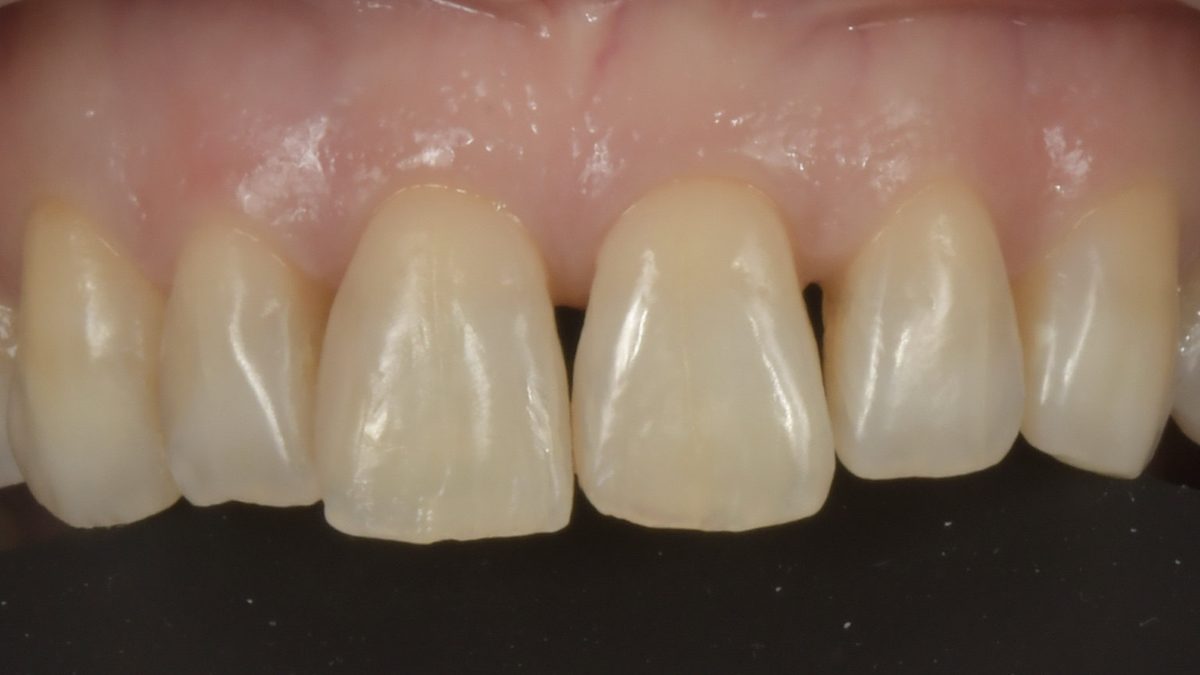
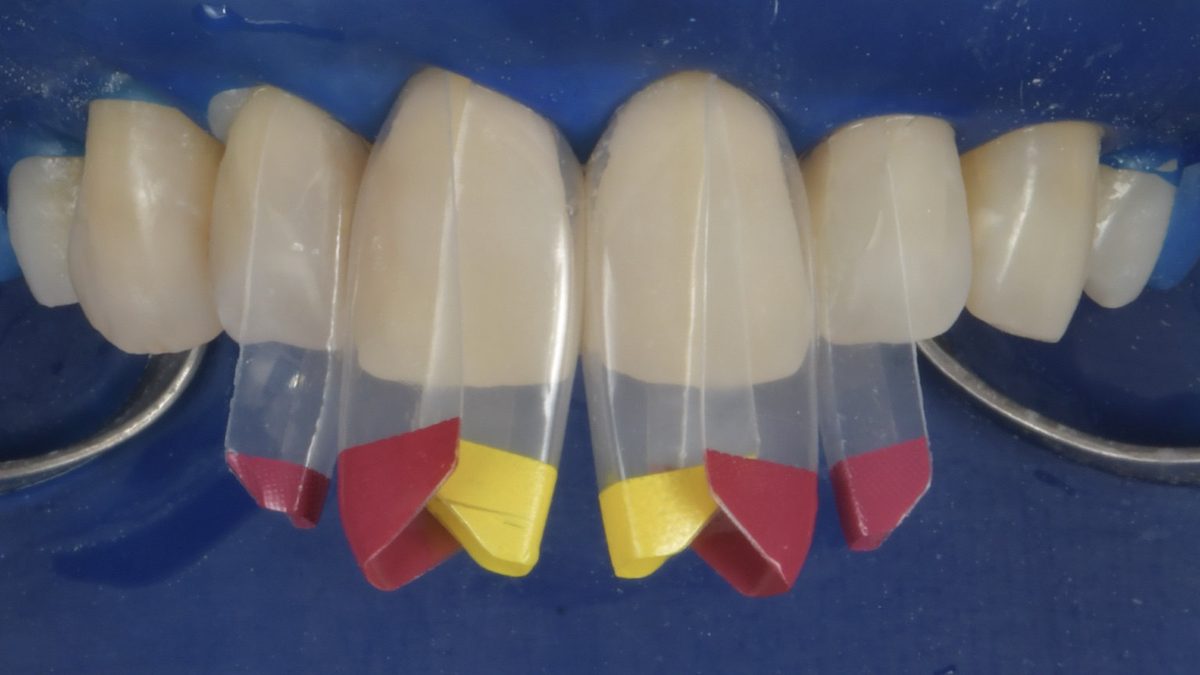
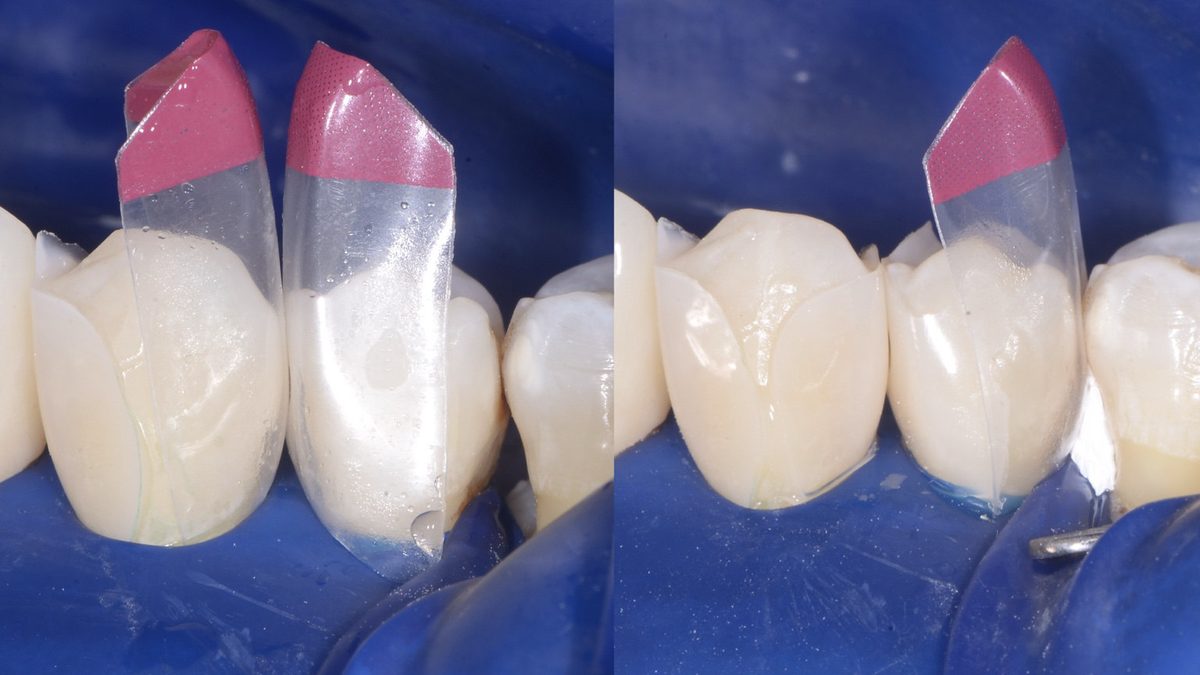
This is precisely the rationale of hyper-anatomical Black Triangle matrices. Their geometry does not simply reproduce the existing tooth. It intentionally exaggerates cervical convexity to replace part of the volume previously occupied visually by the papilla. Different matrix profiles provide progressively greater cervical emergence according to the amount of anatomical correction required. The new emergence profile is also easy to visualize after placement of the matrices. (Figs. 18-23)
This concept is more important than the brand or the matrix itself.
The restoration should be thought of as a three-dimensional modification of tooth anatomy.
The contact point frequently already exists in black-triangle cases. This is a major advantage compared with diastema closure because the existing contact helps stabilize the matrices and provides a reference for the final anatomy. What is missing is primarily cervical volume.
The restoration therefore needs to move from normal anatomy to what could be called hyper-anatomy: a slightly accentuated but continuous cervical convexity specifically designed to compensate for soft-tissue loss.
This also explains why a wedgeless approach is fundamental when using these matrices. A conventional wedge compresses the cervical portion of the matrix and flattens exactly the emergence profile we are trying to create. The result may be a beautiful proximal restoration that still leaves a residual black triangle.
The matrix is not merely containing composite. It is defining biology, cleansability and aesthetics simultaneously.
04 · Surface quality
The surface nobody should polish
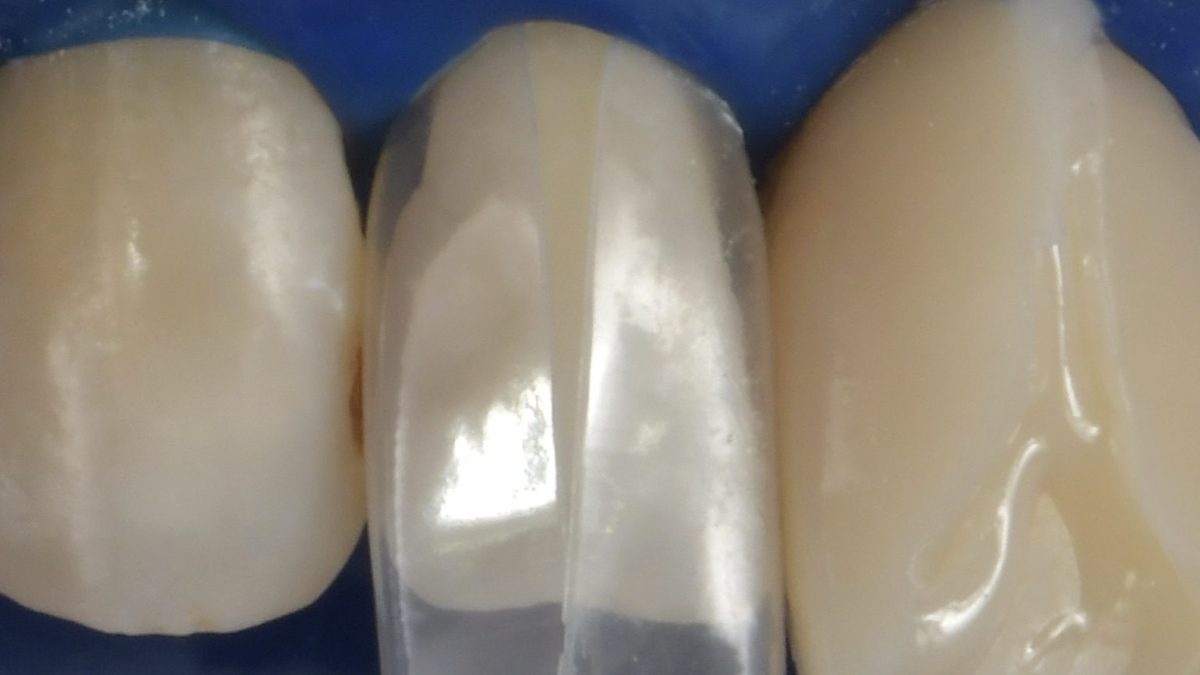
One of the most interesting aspects of using transparent Mylar matrices is what happens to the composite surface itself.
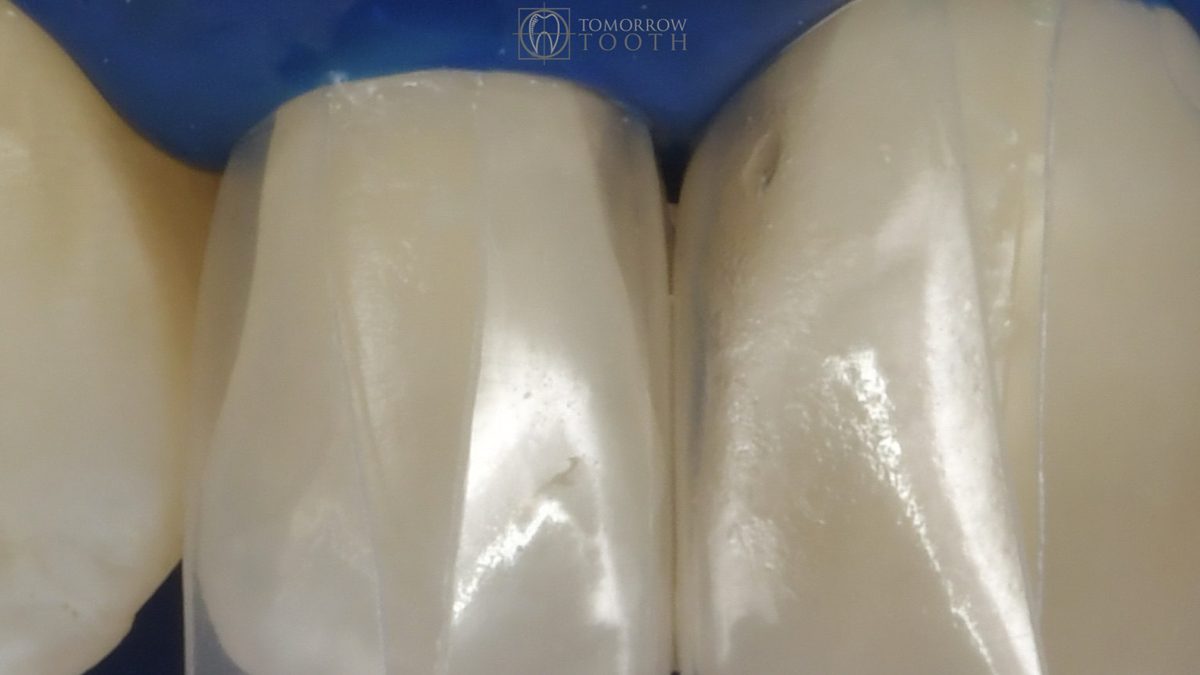
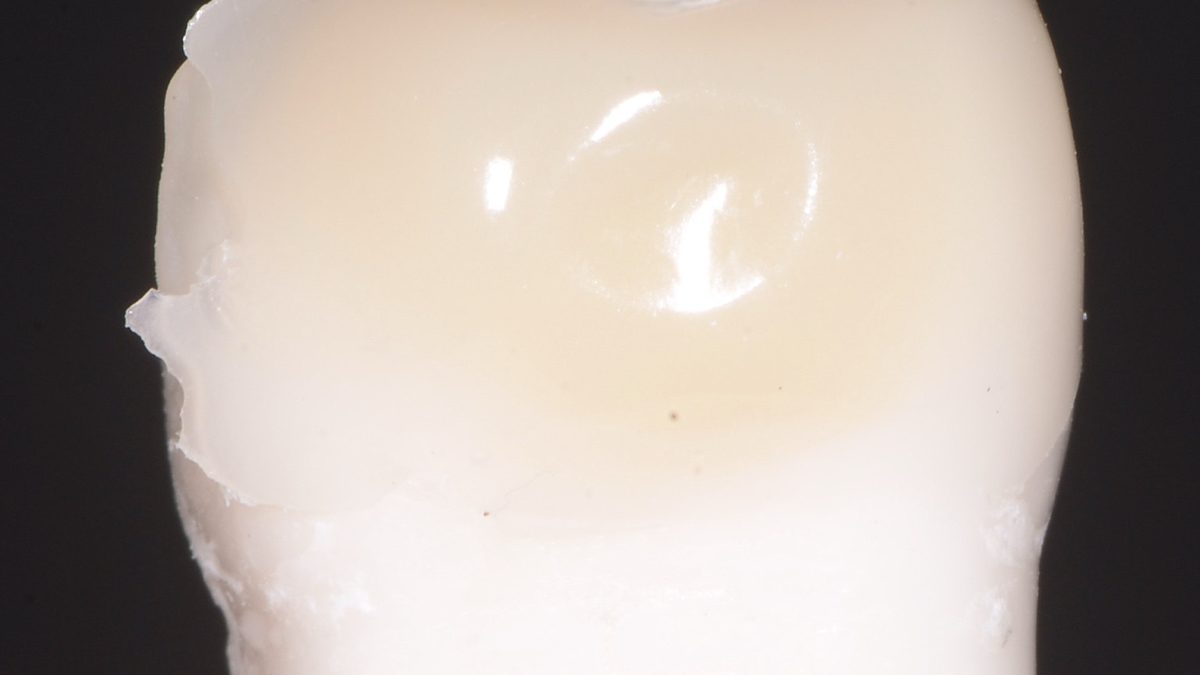
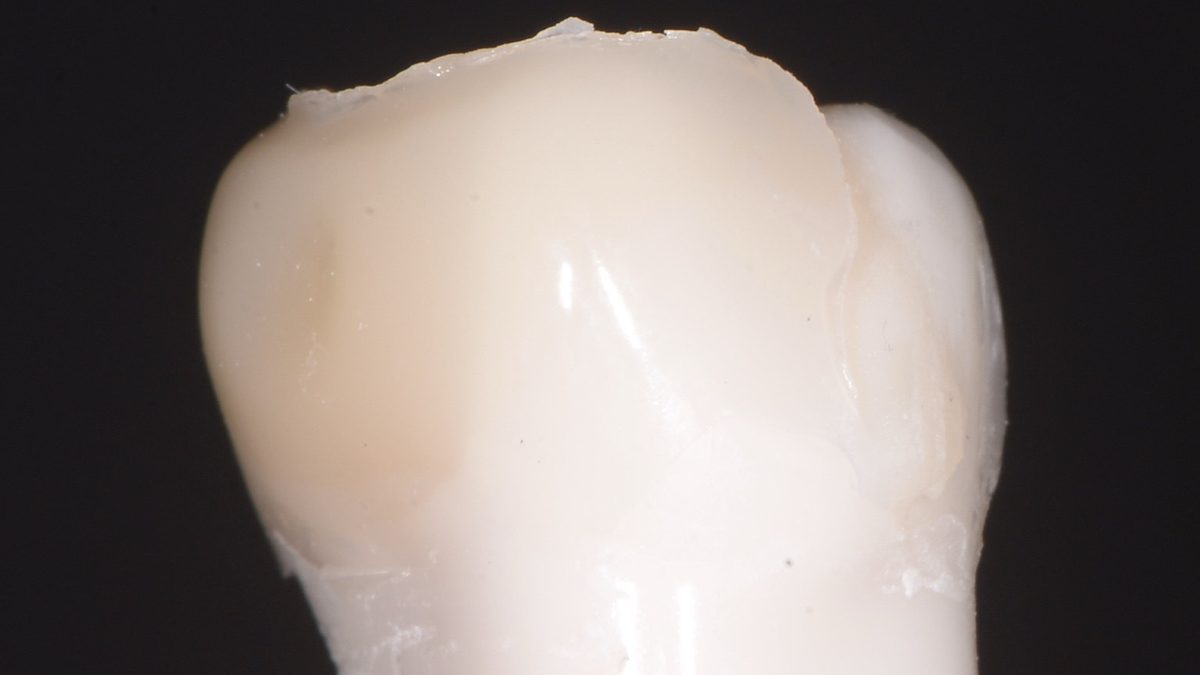
When uncured composite is pressed against a smooth polyester matrix and polymerized, the surface morphology of the matrix is transferred directly to the restoration. The resulting composite surface has extremely low roughness and high gloss, often superior to surfaces produced through mechanical finishing and polishing alone. (Figs. 26-27)
This has a particularly important implication in black-triangle restorations because the area we are reconstructing is interproximal and cervical – the exact area in which finishing is most difficult and biological compatibility is most important.
Every rotary instrument changes the surface.
Even excellent polishing protocols work through controlled abrasion. Resin matrix and fillers are removed differently, generating a microscopic topography of scratches and irregularities. A surface polymerized directly against Mylar, by contrast, reproduces the smoothness of the matrix.
This is why the untouched Mylar-generated proximal surface should be regarded as a final surface, not an unfinished surface.
Finishing should be concentrated where excess material has intentionally been displaced and where instruments have easy access, typically on the facial and lingual/palatal aspects. The interproximal surface formed against the matrix should ideally remain untouched.
The biological relevance is straightforward. Surface roughness influences plaque retention and biofilm maturation. Below certain roughness levels, a surface is generally less favorable to bacterial plaque accumulation; as surface irregularity increases, retention becomes easier. Smooth surfaces also provide fewer microscopic niches for pigments and debris.
The goal is therefore not merely to create a restoration that looks polished.
It is to manufacture the critical cervical-interproximal surface in a way that minimizes the need for polishing in the first place.
For a restoration whose success depends on long-term coexistence with the gingival tissues, this may be more important than producing sophisticated facial micro-anatomy.
05 · Monolithic restoration
Monolithic composite: simplicity as a structural advantage
The second characteristic I consider important is the monolithic nature of the restoration.
Traditional anterior composite dentistry has strongly emphasized layering. The concept is attractive: different masses reproduce dentin, enamel, translucency and optical effects. When the goal is a highly characterized restoration, this can certainly be useful.
But a black-triangle restoration has a different priority.
The amount of composite is relatively limited, the restoration is predominantly proximal, and in many cases sophisticated internal optical layering adds little to the final aesthetic outcome. What becomes more relevant is the structural consistency of the restoration.
Every increment introduced manually creates another interface. Even when bonding between composite increments is clinically adequate, multiple interfaces create additional potential planes of discontinuity. Manipulation of relatively viscous composite with hand instruments may also introduce microvoids or bubbles, particularly in narrow and difficult-to-access geometries.
Injection molding approaches the problem differently.
Preheated composite is injected under pressure into an anatomical matrix, allowing the restorative material to occupy the available volume more continuously with less risk of voids and porosity.
For black triangles, this is exactly what we need.
One shade. One restorative mass. One continuous emergence profile.
The objective is not to demonstrate how many composite masses we can place into a tiny restoration. It is to create a restoration that becomes visually invisible, structurally coherent and biologically maintainable.
In the author’s long-term clinical observation, monolithic injected restorations have also shown a different aging pattern compared with conventionally layered restorations. The proposed explanation includes fewer inter-layer interfaces, less internal porosity and fewer microscopic pathways potentially available for pigment and fluid penetration. This remains partly clinical observational evidence rather than an absolute material-science conclusion, but the rationale is compelling.
06 · Long-term endpoint
The real endpoint: not the photograph, but aging
Black-triangle closure is often presented as an aesthetic procedure. It certainly is. But focusing only on the immediate photograph misses much of its value.
A successful result at time zero is relatively easy to define: the dark space disappears, proportions remain acceptable and the restoration integrates chromatically.
The more meaningful questions come later.
Is the cervical profile still easy to clean? Is the gingiva healthy? Has the composite maintained its surface? Are the margins becoming stained? Can floss or an interdental aid pass without catching? Has the restorative mass maintained its optical integration? Most importantly, was healthy tooth structure preserved?
When viewed through this perspective, the treatment of black triangles becomes an almost ideal example of modern additive restorative dentistry.
The procedure begins with respect for the substrate rather than removal of it. Surface decontamination replaces unnecessary preparation. An anatomical matrix replaces freehand sculpting in the area where freehand sculpting is least predictable. A hyper-anatomical emergence profile replaces the missing visual volume of the papilla. Mylar creates the critical proximal surface directly instead of asking the operator to reproduce it later with rotary instruments. And a monolithic composite mass reduces unnecessary internal complexity.
The aesthetic improvement is immediate, but aesthetics is only the visible consequence of a much broader strategy.
We are not simply closing a black triangle.
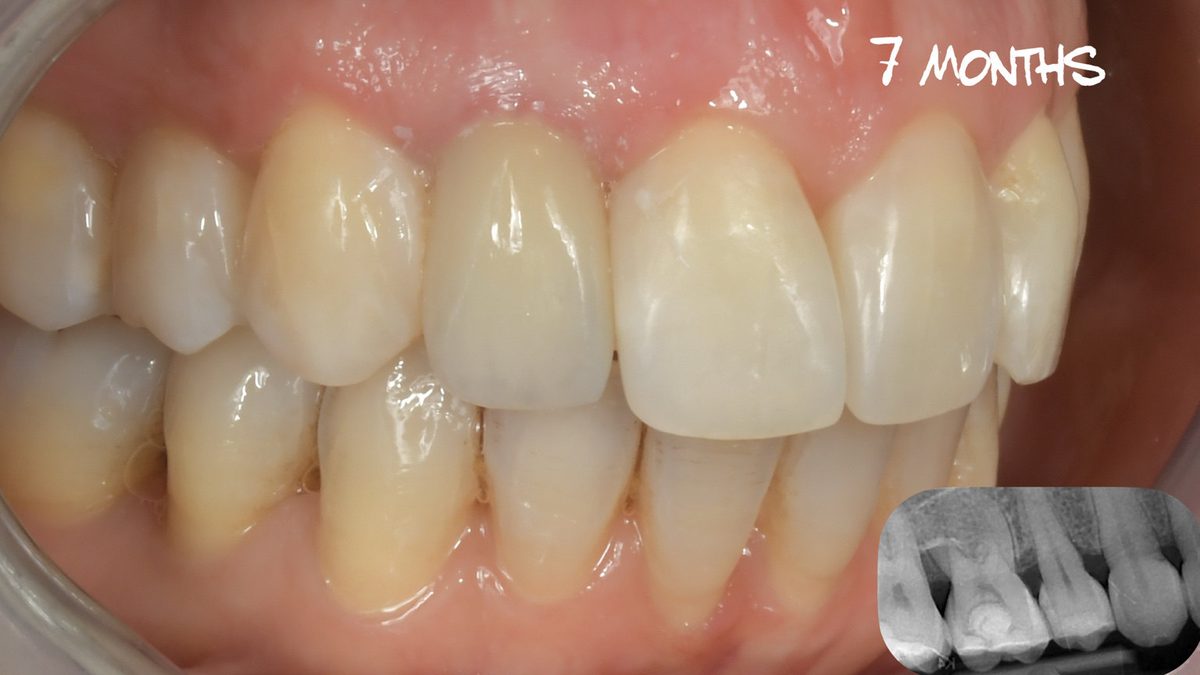
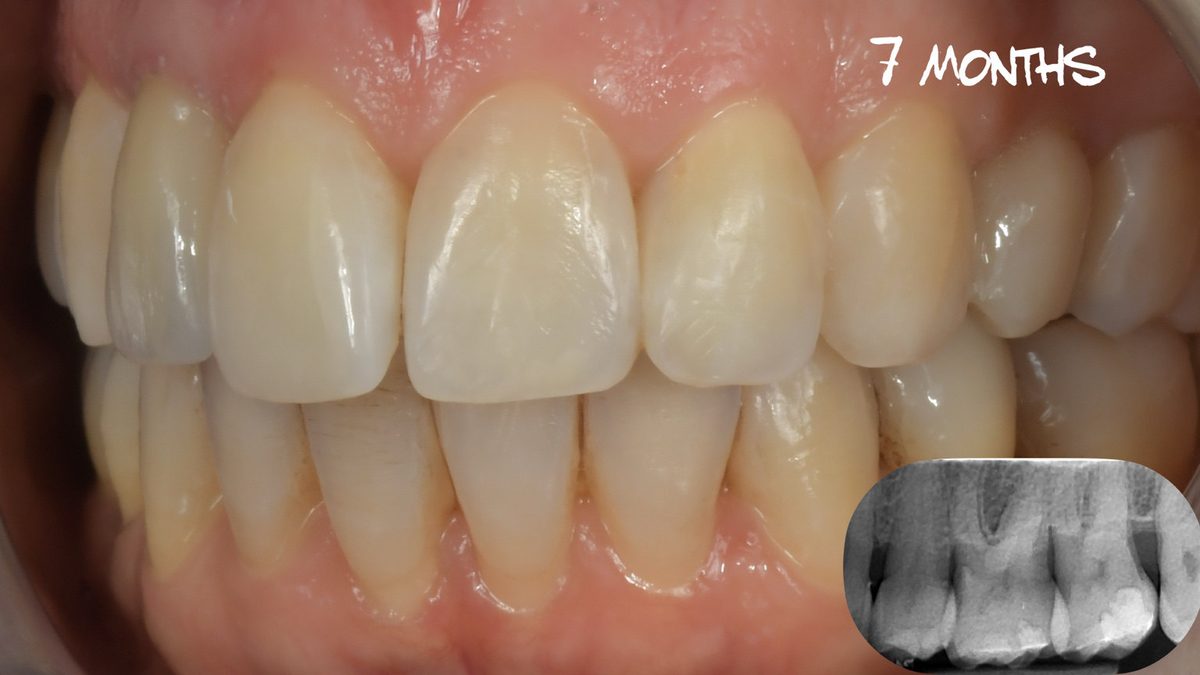
We are redesigning the relationship between tooth, restoration and soft tissue while paying almost no biological price in healthy dental structure. (Figs. 28-33)
That, more than the disappearance of the dark space itself, is the real advantage of an additive approach.
Take-home
The aesthetic improvement is immediate, but the real value lies in how the restoration ages: a maintainable emergence profile, a smooth proximal surface, healthy soft tissues and the preservation of sound tooth structure.
Article and clinical photography: Marco Maiolino

About the author · Marco Maiolino, DDS
Restorative dentistry | Education | Longevity. Marco Maiolino graduated in Dentistry with honors from the University of Perugia in 2001. His clinical work focuses on adhesive restorative dentistry, minimally invasive techniques and the restorative-prosthetic continuum, with operative microscopy as an integral part of his practice since 2006. Co-founder of Tomorrow Tooth and a Bioclear Instructor since 2021, he lectures internationally and has presented in more than 20 countries. He practices in Syracuse, Italy, combining clinical dentistry, education and a strong interest in the long-term behavior of restorative treatments.
More about the author: marcomaiolino.it